
Preventive maintenance
Schedule your hotel preventive maintenance
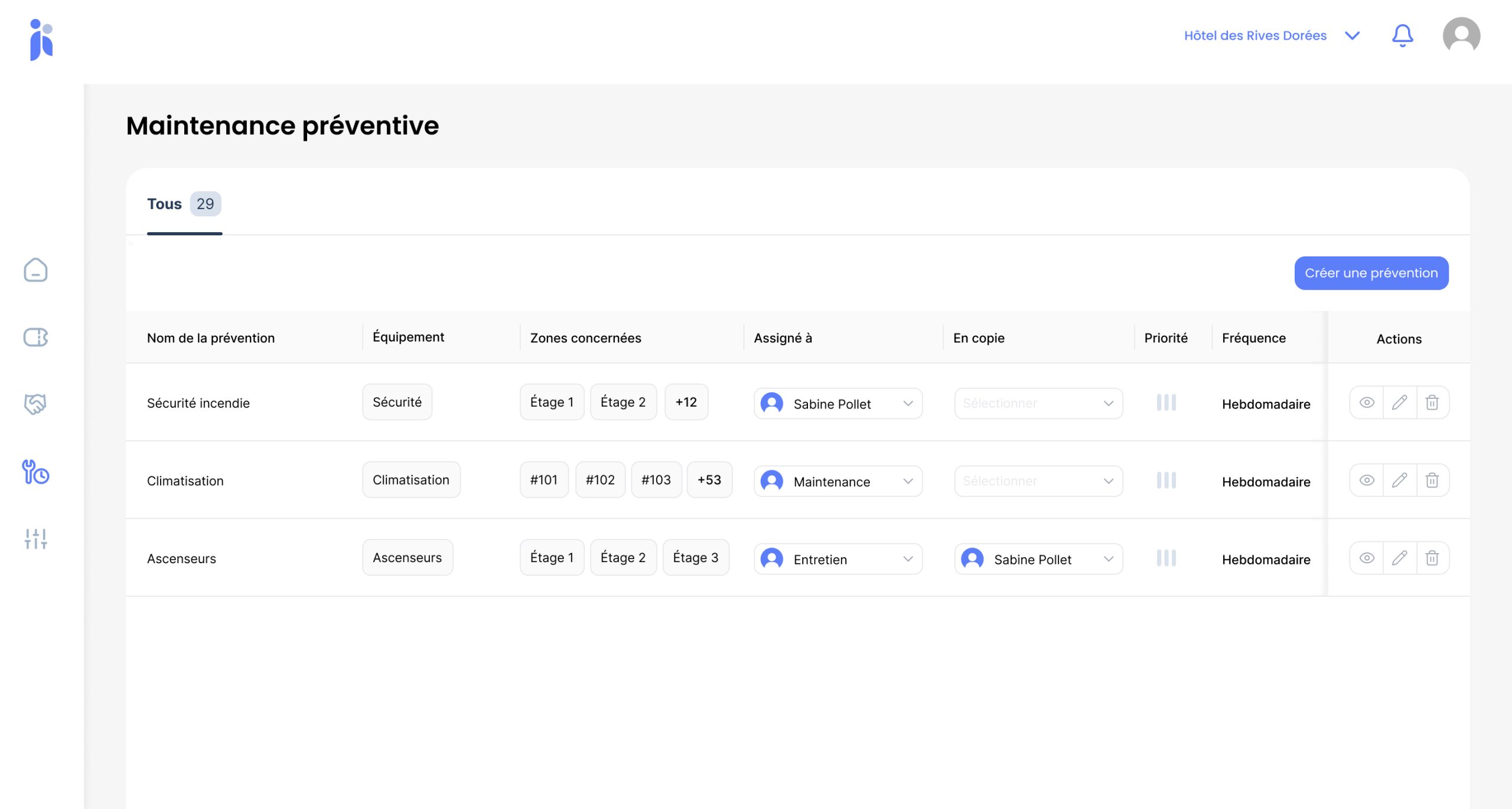
Inara turns your recurring servicing into a living calendar, tied to every asset and every site. Due dates come round on their own, work orders raise themselves, and your technicians know what needs doing before a guest ever notices. Anticipating always costs less than repairing.
- A calendar per asset
- Frequencies you set
- Work orders raised for you
- One view of the estate
A breakdown in a hotel never costs just the repair
When equipment fails in a hotel it does not take a machine out of service: it takes a room out of service, pushes back a conference, wakes a guest at two in the morning. The plumber's invoice is the visible part, and the smallest.
Preventive maintenance means scheduling work to a rhythm decided in advance - usage, age, the manufacturer's recommendations, the season - instead of absorbing breakdowns as they come. In hospitality it runs into a difficulty specific to the sector: due dates are scattered across dozens of equipment types, often over several buildings, and they live in the head of the maintenance manager or in a folder nobody ever opens again.
The room out of service
A bathroom out of order is a night that does not get sold - and that you never make back.
The emergency call-out
Unplanned repairs are paid for in premium hours, in waiting time and in parts ordered in a rush.
The online review
Guests do not rate the breakdown, they rate the way it disrupted their stay. The review stays online.
What you schedule in Inara
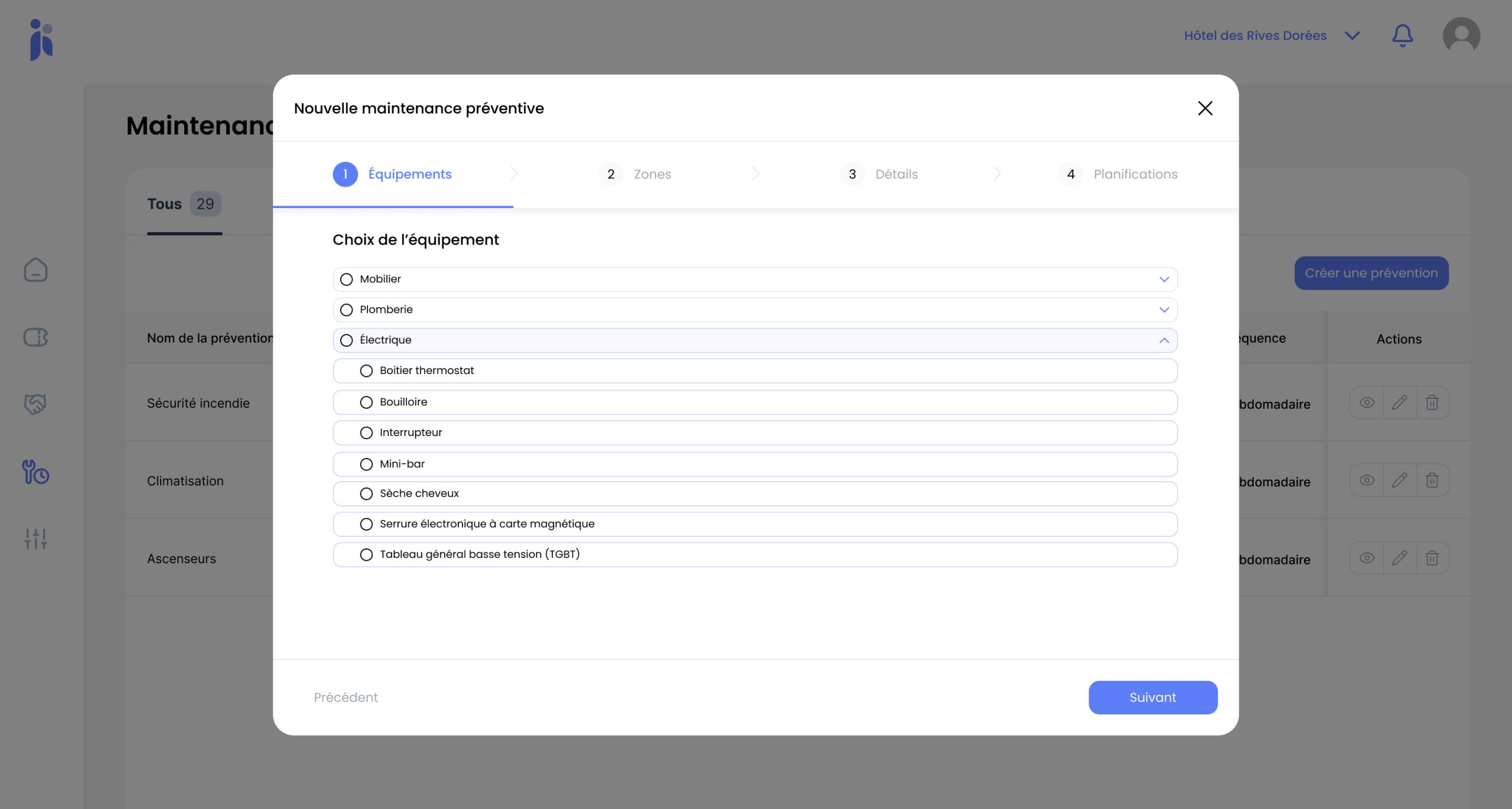
Preventive maintenance is not a separate module: it sits on the same tree of sites, zones and assets as your corrective work. What you set up once serves everywhere.
-
A calendar attached to every asset
Each service is tied to the asset concerned, which itself sits in a zone and a building. You no longer have to ask when the last service took place: the answer is on the asset record, with its history and every past job.
-
Frequencies that follow real use
Weekly, monthly, quarterly, annual, or a rhythm of your own: you set the pace asset by asset. A boiler from 2004 and one fitted last year do not call for the same calendar - and neither does a junior suite that is occupied every night.
-
Recurring tasks that raise themselves
Periodic cleaning, checks, lubrication, meter readings: instead of keeping them in mind, you describe them once. Inara raises the work order on the due date, assigns it to the right department and drops it into the technician's list like any other request.
-
A consolidated view of the estate
Across one property or ten, you see at a glance what is falling due, what has been done and what has slipped. That view is what lets you decide between one more repair and a replacement.
From set-up to routine
A preventive maintenance plan is not written in a day. You build it once, then it runs.
-
You map out your property
Sites, buildings, floors, zones, rooms, then the assets they contain. That is the base everything else hangs on.
-
You decide the rhythms
For each equipment family, the frequency and the department responsible. The manufacturer's recommendations give you the starting point; what you see on the ground does the rest.
-
Inara raises the work orders on the due date
They land in the right department's list, with the right location and the right context. Nobody has to remember them.
-
Your teams carry out the work on site
From the mobile app, at the end of a round or between two jobs, with photos to back it up where needed. The history builds itself.
-
You fine-tune with the statistics
Assets that keep coming back, due dates that are always pushed back, the zones that eat the most time: the figures tell you where the plan needs correcting.
What you gain
Fewer rooms out of service. Failures that give warning are dealt with before the room is taken offline.
Fewer emergencies paid at a premium. A planned job can be prepared, grouped with others and negotiated.
Equipment that lasts longer. Regular servicing pushes replacement further out, item by item.
Traceability that stands up. Every visit is dated, described and tied to its asset.
A handover that does not start from scratch. The plan no longer lives in one person's head.
A budget you can defend. Figures replace instinct when the time comes to decide.
Frequently asked questions
What is the difference between preventive and corrective maintenance?
Corrective maintenance repairs after the breakdown; preventive maintenance steps in before it, to a calendar decided in advance. Both are necessary: no property ever removes the unexpected entirely. The aim is to shift the volume steadily from corrective work you simply absorb towards planned preventive work, which costs less and disrupts the operation far less.
Where do you start when nothing has been written down?
With the assets whose failure blocks a room or a service: hot water production, air conditioning, lifts, kitchen equipment. A dozen lines that are properly kept are worth more than an exhaustive plan nobody follows. The rest is added month by month, as the habit takes hold.
Do you need a dedicated technician for this to work?
No. Plenty of properties run their preventive maintenance with a multi-skilled team, sometimes a single maintenance person on site, backed up by contractors on the regulated items. What matters is that the due dates live somewhere other than in someone's memory, and that each one is assigned to a named person.
How do you handle several properties?
Each site keeps its own tree and its own due dates, while the consolidated view lets you compare sites, spot the ones falling behind and pass good practice around. A single template plan can serve as the basis for several comparable properties.
What happens to statutory obligations?
The checks required for public buildings - fire safety, lifts, electrical installations, hot water systems - are scheduled like any other servicing, at their legal frequency. The main benefit is the record: an inspector asks to see a history, not an intention.
How long before you see an effect?
The first visible effects are organisational and come quickly: nobody hunts for the date of the last job any more, and due dates stop slipping through the net. The financial effects follow the pace of your servicing cycles: they are measured over a full season, not over a few weeks.
Explore further
The Inara features that keep a preventive plan running day to day.
Let us look at your maintenance plan together
Thirty minutes, on your own equipment and the way your teams actually work. No commitment.